

01
Ingest your visual data
Connect folders, campaigns, references, and working files from the tools your team already uses.
5 billion images are created every day, only 0.1% are visible. Context like brand guidelines, approvals, and rights clearance remains invisible to AI that only sees pixels.
PoolDeck tackles the entire visual workflow preceding DAMs: concepts, reviews, handoffs, and launches.
Who approved the asset, when, for which use, and under what constraints.
How the asset maps to brand rules, visual identity, campaign standards, and permitted usage.
Where the asset came from, who created it, source files, AI-generation status, edits, and authenticity signals.
How the asset connects to campaigns, products, references, variants, source materials, teams, and downstream outputs.
What changed, when it changed, why it changed, and which version is approved for use.
How the asset performed across channels, including engagement, conversion, retention, or sales impact.
PoolDeck takes assets from wherever they are, automates context, and delivers useful assets wherever you need them.
Connect folders, campaigns, references, and working files from the tools your team already uses.
Our SPLaSH context engine reads each asset through your required context parameters, e.g. brand, audience, campaign, rights, and performance, then writes a versioned record of what it means.
Teams search by meaning in the web app. Agents and pipelines retrieve the same context through the headless API, with a CLI and MCP 2 on the way.
Structured visual context gives emerging AI systems the meaning they need to understand, retrieve, and reuse media assets.
Agent asks: Is this image compliant with both Heinz and Heineken brand requirements?
In testing, PoolDeck context lifted an agent's brand-compliance accuracy from 33% to 98%, at 100x lower cost on repeat calls.
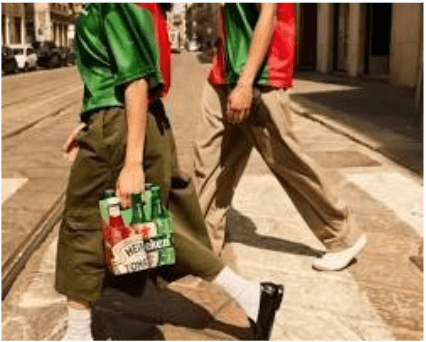
Did not correctly identify compliance. The model missed the required responsible drinking message and gave the wrong verdict.
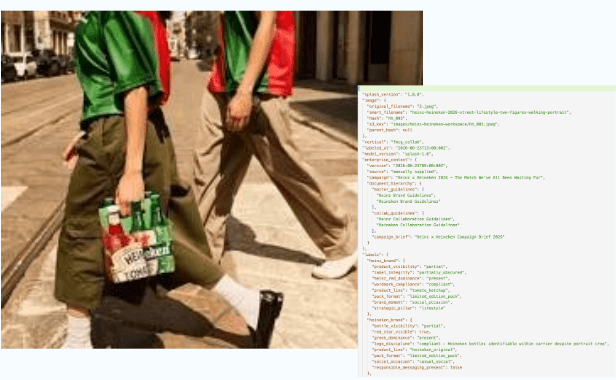
Correctly identified compliance. The model found the image visually on-brand, but not paid-media compliant until responsible drinking copy is added.
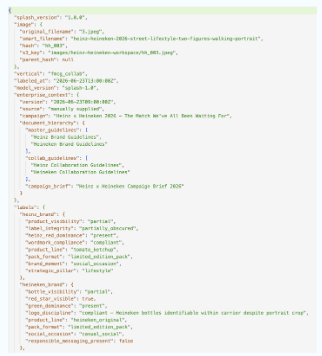
Correctly identified compliance without reprocessing the image. With routing, the model only needs the relevant compliance fields.
Agent answers: Visually on-brand, but not paid-media compliant until responsible drinking copy is added.